
Network Convergence Gateway for Wireline Operators

Overview

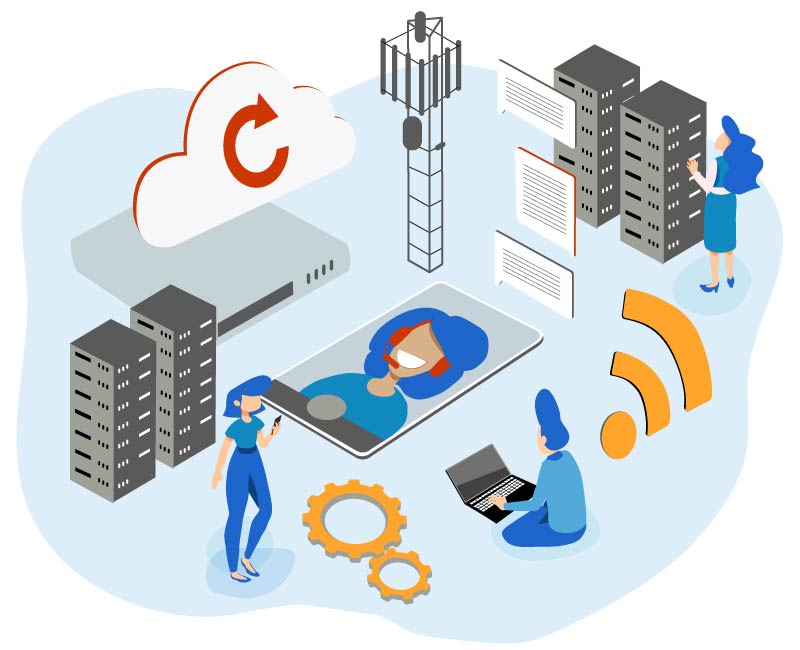
The Network Convergence Gateway (NCG) is a carrier-based, core network, fixed mobile convergence (FMC) server that bridges broadband and mobile networks in both pre-IMS and IMS environments. The NCG converges the personalization and mobility of mobile phone services with the flexibility, innovation and outstanding cost economics of the rapidly growing VoIP sector.

With the NCG, service providers can extend single-number mobile voice, text, multimedia messaging and video services to residential, corporate and hotspot locations with broadband access. This is achieved via SIP on a service provider's existing networks while preparing them for the IMS (IP Multimedia Subsystem) platform of the future.

To further enhance CounterPath’s NCG, hosted services are available for wireline operators who do not wish to invest the time and additional infrastructure in developing their own services. CounterPath’s NCG Exchange hosted services are fast to implement, inexpensive and work on any mobile phone on any mobile network.


NCG Wireline Applications

SMS (Text) Messaging

Enables SMS capability for VoIP users for both inbound and outbound messages, as well as store and forward message functionality for off-line VoIP users.

Instant Messaging (IM) and Presence

Provides VoIP users IM and presence capability that leverages their VoIP identity and can be used in conjunction with CounterPath’s Bria desktop and mobile softphone clients.

Wireline Mobility

Allows wireline operators to extend their messaging and voice services to any mobile device on any mobile network.

Wireline Call Continuity (WCC)

Enables users to move calls from their desktop or mobile VoIP phone to another device, including their standard mobile phone or smartphone. This eliminates the inconvenience with switching phones when in a conference call or asking someone in a direct conversation if you can “call them back from the car” or if you can “switch to your office phone.”


Benefits for Service Providers

  • Additional revenue source
    • Users understand the value of single number identity and will pay for a single number service that includes voice and SMS to their mobile phones.
  • No need to replace mobile networks’ SMS infrastructure
    • CounterPath’s solution allows for this service on any mobile phone across any carrier, no relationship required.
  • Maintain wireline relevance
    • In an era of shrinking wireline subscription, wireline mobility service is the answer to maintaining service relevance.

Benefits for Consumers

  • One-number accessibility
    • A user’s wireline number is now the fastest, most convenient way to reach that person via voice or text message, regardless of where they are and what device they are using. Wireline service follows customers to their mobile when they are not at their home or business.
  • Fixed-mobile convergence convenience and savings
    • Customers using their smartphone or PC at home or in a Wi-Fi hotspot can have their wireline VoIP number ring their mobile phone, minimizing phone tag. They also reduce use of their monthly cache of cellular plan minutes and SMS messages, saving them money.
  • Network-agnostic flexibility
    • CounterPath’s Wireline Mobility Service works with any mobile phone on any wireless network. This feature allows users the flexibility to switch between carriers and devices, while seeking out the best deals and latest smartphones, all without disrupting their reachability.


NCG Exchange

CounterPath’s NCG Exchange is a hosted service that enables wireline operators in offering enterprise, SMB and SOHO customers with an immediate solution for mobile VoIP and messaging services that are delivered over-the-top (OTT) of mobile networks. These services are both network- and device-agnostic, meaning that operators can issue a single VoIP phone number to their customers to be reached by voice, IM or SMS.

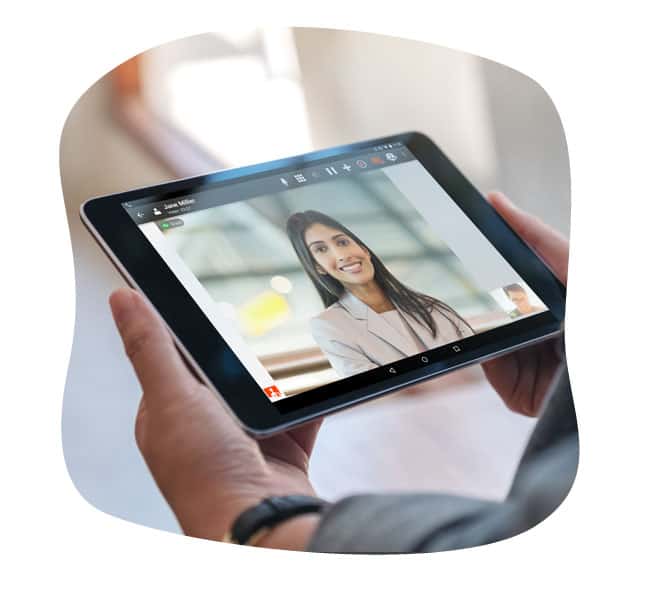
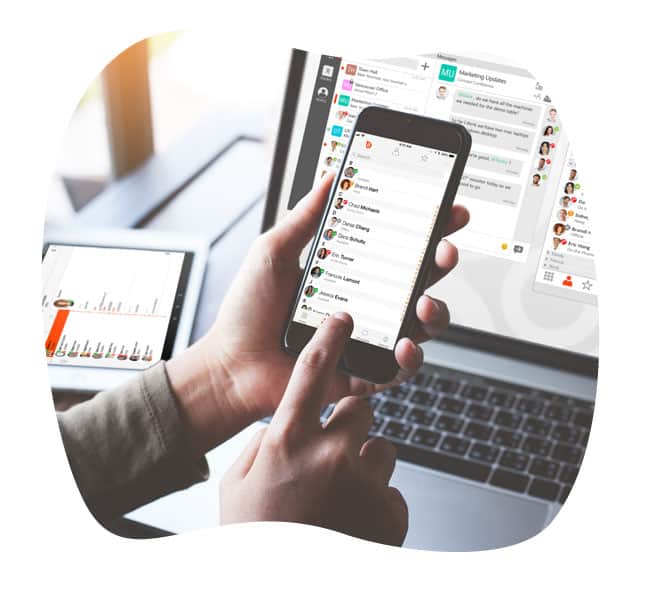
The NCG Exchange is both hosted and provisioned by CounterPath and works with any mobile handset – including smartphones and feature phones – without any requirement to install additional software on the device. The service can be enhanced with the use of CounterPath’s mobile softphone clients, Bria iPhone Edition and Bria Android Edition, which allow customers the option of communicating over Wi-Fi and 3G/4G along with their standard mobile voice and SMS channels. Additionally, operators can also leverage CounterPath’s Bria desktop and laptop softphones for Mac and PC to further enhance their customers’ communications services by allowing them to mirror their desktop Bria with their mobile phone. This allows users to send and receive calls and messages as well as move calls between both their desktop softphones and mobile phones.


Benefits to Wireline Operators

  • Additional revenue source. With the majority of mobile users already paying for SMS services, wireline operators can capitalize on this premium service by offering two-way (SMS-to-VoIP and VoIP-to-SMS) messaging services to their customers.

  • Value-added services. Operators can provide customers with value-add VoIP and mobile applications on top of their wireline number.

  • Leverages strength of the softphone. Using Bria as the foundation underneath the NCG Exchange service allows operators to build stickiness around their product suite.

  • CapEx-free implementation. NCG Exchange does not require any additional network infrastructure to launch and no new customer handsets, tablets or PCs are necessary.

  • Expedited launch timing. Operators can implement NCG Exchange services within weeks instead of months and can also take services in-house as they ramp traffic on the NCG Exchange platform.

Carrier-Grade Reliability

CounterPath’s infrastructure is built out in the way that operators would construct their own network. The goal is to be a natural extension of each operator’s network and the services CounterPath provides will augment your own by providing messaging and mobility capabilities.

CounterPath has deployed the NCGs that are used to host the NCG Exchange service in a carrier-grade manner. This includes detailed planning with respect to space, power, cooling, and network to ensure that services are provided with redundancy, resiliency, reliability, and appropriate capacity.

NCG Exchange Diagram To ensure carrier-class reliability, CounterPath leverages the infrastructure provided by our colocation, ISP, and messaging network partners. This makes sure that the basics are in place and we can rely on features like redundant power feeds and multiple upstream ISPs to support our infrastructure.

CounterPath has also worked through the details, for example the use of miimon monitoring to bond all server Ethernet interfaces for both redundancy and optimum link failover performance. We employ SNMP, port scanning, and session based monitoring to monitor our network internally. CounterPath also uses an external monitoring service to watch our own monitoring platform and our major infrastructure items.


Applications

The NCG is the core enabling technology behind CounterPath's suite of Wireline Applications:

Wireline Messaging – SMS, Instant Messaging and Presence

CounterPath’s Wireline Messaging is enabled by the messaging engine embedded in the NCG for Wireline Operators. VoIP operators can now have their subscribers trade SMS messages with all mobile networks as a peer.

The NCG allows SMS capabilities for VoIP users for both inbound and outbound messages and store and forwards messages for offline VoIP users. For the first time, Wireline Operators are able to offer competitive SMS services without any formal relations with any mobile operator. Even more, wireline providers are able to leverage devices other than mobile phones for SMS delivery including CounterPath’s Bria softphone for Windows and Mac.

Beyond SMS messages, the NCG enables Instant Message and presence capability so that Wireline Operators may design and deploy their own community bundled with their traditional wireline voice services. As with the SMS service, the Instant Messaging services include a store and forward function that enables off line messages to be delivered when a user becomes available. In addition, the NCG also include an XCAP server that manages buddy lists and policy for subscriptions to presence or other types of events published via SIP.


Benefits for Wireline Operators

  • No need to replace mobile networks’ SMS infrastructure
    • CounterPath’s solution allows wireline subscribers to communicate via SMS with the subscribers of any mobile phone operator; no direct relationship required.
  • Maintain wireline relevance
    • In an era of shrinking wireline subscriptions, wireline mobility service is the answer to maintaining service relevance.

Benefits for Enterprises

  • Wireline SMS for businesses
    • Businesses can now use test messaging with their main telephone number, making them more accessible to customers – especially those in younger demographics – who prefer texting over emailing or calling

Wireline Call Continuity (WCC)

Wireline Call Continuity (WCC) enables a Wireline Operator to offer call handover services for their subscribers. With this service, users are able to move calls from their VoIP service to other endpoints, including mobile devices. For example, if a user starts a call on their work PC using Bria for Windows, they can move that call to another device – like their mobile phone – without dropping the call.


Benefits for Wireline Operators

  • Offer mobility services to your subscribers while leveraging other Operators’ investments in mobile assets
  • Allow subscribers to choose and change their Mobile Operator without concern for losing their identity, which is safely tied to their telephone number from the Wireline Operator
  • Provide “stickiness” thought service extension across the mobile network; make wireline services mobile

Benefits for Enterprises

  • Move calls from your desktop softphone to your mobile phone without call interruption
  • Your wireline number finds you no matter what network you are on
  • More than ever, enterprises want and need to control their communications. By providing employees with a mobility solution they can maintain employee mobility while controlling usage.

Wireline Mobility

CounterPath’s Wireline Mobility enables users to user their basic mobile phone to communicate with voice and SMS using their wireline number. There is no mobile client to install and no smartphone required – users can start receiving, replying to and sending calls and SMS messages using their basic mobile phone from any provider.

Simply put, the user can take advantage of the mobile device they already have, and are under contract with, and pair their mobile number with a Wireline Mobility service. Now any time a voice call or IM/SMS message is sent to their wireline number, the user will receive it on their mobile device as well.

Wireline Mobility Features

  • Support on ANY mobile phone on ANY mobile carrier
  • NO additional mobile phone client or software is required; but if you have Bria Mobile you can reduce mobile usage when your mobile is IP connected
  • Voice calls and SMS messages to the wireline number are delivered to the users mobile phone (and their wireline and VoIP devices, if applicable)

Benefits for Wireline Operators

  • Leverages third-party wireless networks for wireline services
  • Enable services to be agnostic to mobile protocols and devices

Benefits for Consumers

  • Significant cost-savings by reducing the use of calling plan minutes and allocated SMS limits with your cellular plan provider
  • Use the identity that best suits your communications needs (wireline for home/business calls; mobile for select calls)

Specifications

SIP

  • Session Initiation Protocol (IETF RFC 3261)
  • Reliability of Provisional Responses in SIP (RFC 3262)
  • Offer/Answer Model with SDP (IETF RFC 3264)
  • SIP Specific Event Notification (RFC 3265)
  • Session Description Protocol (SDP) (IETF RFC 2327)
  • REFER Method (RFC 3515)
  • Message Waiting Indicator (RFC 3842 and RFC 3265)
  • Session Initiation Protocol for Instant Messaging and Presence Leveraging Extensions (SIMPLE) to SMS (RFC 3428)
  • Basic Network Media Services (RFC 4240) for Tones and Announcements
  • HTTP Digest Authentications Using AKA (RFC 3310)

SMS, IM and Presence

  • SMPP – Short Message Peer-to-Peer Version 3.3, 3.4, and 5.0
  • RFC 3265 – Session Initiation Protocol (SIP)-Specific Event Notification
  • RFC 3856 – A presence Event Package for the Session Initiation Protocol
  • RFC 3857 – A Watcher Information Event Template-Package for the Session Initiation Protocol
  • RFC 3863 – Presence Information Data Format (PIDF)
  • RFC 3860 – Common Profile for Instant Messaging
  • RFC 3859 – Common Profile for Presence
  • RFC 3903 – Sip Extensions for Event State Publication
  • RFC 4825 – The Extensible Markup Language (XML) Configuration Access Protocol (XCAP)
  • RFC 5025 – Presence Authorization
  • Presence SIMPLE Specification, Open Mobile Alliance, OMA-TS-Presence_SIMPLE-V2_0-20090917-C
  • XML Document Management (XDM) Specification, Open Mobile Alliance, OMA-TS-XDM_Core-V1_0_1-20061128-A

OSS/BSS

  • Event Detail Record Generation via FTP or RADIUS
    • RADIUS Accounting/CDR Generation (RFC 2866)
    • RADIUS Authentication Client (RFC 2865)
  • OS Resource Monitoring / High Availability
  • SNMP v 2C Alarm Monitoring, Statistical Gathering
  • MIB II (RFC 1213)
  • Subscriber Trace

Operating System

  • Redhat Linux Redhat Enterprise Linux 5 Update 5

Standard System Configurations

  • Small Configuration
    • 2 IBM X Series Servers or 2 Blade Servers
  • Scalable 2/2/2/4 Redundant Configuration
    • 2 IBM Blade Center T or E Chassis
    • 2 Convergence Database (CDB) blades
    • 2 Network Signaling Handler (NSH) blades
    • 4 Convergence Services Gateway (CSG) blades

Hardware (Minimum Specifications)

  • IBM Blade Server (T or E Chassis)
    • 4 Power Supplies/Chassis
    • 2 Management Modules/Chassis
    • 2 1 Gigabit Ethernet Switch/Chassis
    • NEBS 3 and ETSI certified for T Chassis
    • 19” rack width Chassis
    • Either AC or DC power
    • No single point of failure
    • Hold up to eight (8 or 14) blades
  • IBM Blade Servers or 1U X Series Servers
    • 2.6 6C GHz CPU
    • 12G RAM
    • 80G Hard Disk: Two 80G SCSI drives in RAID1 configuration
    • Dual Gigabit Ethernet ports per server

System Performance

  • 100,000 BH simultaneous registrations per CSG blade
  • 100,000 BH Voice, SMS, or MMS call/transmission attempts per CSG blade


Pricing

CounterPath’s Network Convergence Gateway (NCG) solution for Wireline Operators is designed for large scale deployments by service providers and OEM customers. As such, a minimum volume license commitment is required.

To inquire about the NCG solution, please complete and submit the Sales Request Form and a CounterPath sales representative will contact you with more information.


Videos

Loading the player ...